Doctoral School on Materials Sciences and Technologies
Image:
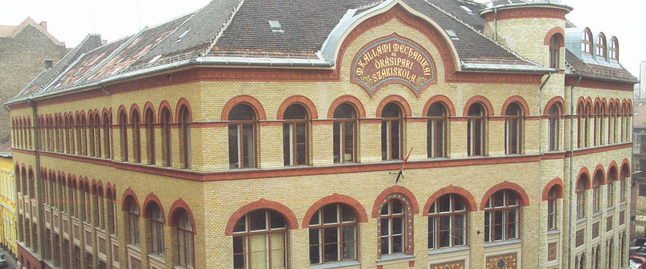
The goal of the Doctoral School of Material Sciences and Technologies is to train academics and professionals who have a comprehensive understanding of materials sciences and profound knowledge in a specific area and can perform individual, creative research in materials sciences and work with the practical applications.
Supervisors and professors of the Doctoral School are the teachers and researchers with outstanding scientific records from three faculties of Óbuda University (Rejtő Sándor Faculty of Light Industry and Environmental Engineering, Kandó Kálmán Faculty of Electrical Engineering, and Bánki Donát Faculty of Mechanical and Safety Engineering) and other scientists invited from various Hungarian universities and research institutes. Currently, the Doctoral School works with about 80 teachers including 7 core members and 25 supervisors.
Students of the Doctoral School, due to the complex character of materials sciences, must be engineering or science graduates with a deep graduate level knowledge in material sciences, and must be able to demonstrate their knowledge in an admission test. Currently some 25 students are involved in the program; about half of them are from foreign countries. Since 2015 a total of 6 people obtained the PhD diploma from the Doctoral School of Material Sciences and Technologies.
The academic program of the Doctoral School aims at understanding the relations among the structure and the properties of the materials, and at developing new structural and functional materials, by integrating various areas of sciences. The activities and specific areas of the Doctoral School cover macromolecular systems, advanced metals, polymers, ceramics, composites and micro- and nano-structured materials and technologies.
Requirements: During the four years of Ph.D. studies 240 credits should be obtained in a special distribution: Minimum 8 subjects should be fulfilled, selected from various areas of General studies on materials; Methods of materials testing; and specific areas of materials sciences (polymers, ceramics, metals, micro- and nano-structured materials and technologies). Further, students must publish at least 5 publications, among which at least 2 papers have to be internationally refereed professional journal papers possessing an impact factor.
Cím:
Doctoral School on Materials Sciences and Technologies
Doctoral School of Applied Informatics and Applied Mathematics
The Doctoral School of Applied Informatics and Applied Mathematics started its activities in 2009. Its aim is to train researchers – mainly with engineering background – who are familiar with the methods and techniques of informatics, computer science and applied mathematics, and can solve real industrial research and development tasks using multi-disciplinary knowledge, communication skills and teamwork experience. The Doctoral School pays a special emphasis on the cyber-physical systems, robotics, computational engineering and modeling and the applied mathematics that supports these areas.
The Óbuda University and the Universita degli Studi di Milano has a joint PhD Degree program in Informatics since 2011 the participants of which may obtain PhD degree from both universities.
The Rejtő Sándor Faculty of Light Industry and Environmental Engineering is the single HEI in Hungary where students can receive engineer level qualifications in the traditional areas of light industry. The institution offers three B.Sc. and two M.Sc. programs in Hungarian, and two B.Sc. programs for the international students. The work is supported by fifteen educational laboratories and six research laboratories.
The Light Industry Engineering program offers four specializations in specialized fields of the light industry: Creative Products and Technologies, Quality Control System Development, Printing, and Media Technologies, and Packaging and Paper Technologies. The fields offered to the students on the Industrial Design Engineering program are Product Design and Packaging Design specialization. Environmental Engineering training graduates have knowledge and competencies to solve and anticipate today's environmental challenges.
The Faculty is a founding member of several international organizations, an organizer of prestigious international events and a participant in academic exchanges. It maintains active cooperation with the participants of the domestic and international scientific life, and with the industrial partners. The total staff of the Faculty is 48 people. Out of all 24 lecturers, 23 are qualified, giving a faculty qualification rate of 96%. The number of habilitates per institution is 1, the number of pre-graduate doctoral students is 1 (MKI).
Cím:
Rejtő Sándor Faculty of Light Industry and Environmental Engineering
The mission of the Faculty is to manage the BSc and MSc Computer Engineering courses, which enables students to find a place for themselves in the labour market immediately after graduation whilst also preparing them for the second phase of education: the two-year MSc course. Graduates of MSc can further their studies in Applied Informatics Doctoral School.
The curriculum for the BSc in Computer Engineering is seven semesters long. Initially, our students obtain a solid professional grounding which is then followed by their basic computer engineering training. In their fifth semester, our students have to choose a specialisation in which they obtain deep, special and practical competency in one of the current application areas of Informatics. Specialisations include: ambient systems, embedded intelligent systems, informatical and automatized systems, informatics system engineer, mobile informatics, software technology and business information systems.
The curriculum for the Computer Engineering MSc course is four semesters long both in case of full-time and evening learning. The aim is to train computer engineers, who will have the ability to either perform research and development tasks in their field of specialisation or to take part in a PhD programme. Current specialisations in the Computer Engineering MSc course include: Application Management, Integrated Intelligent Systems.
The faculty offers, in connection with basic computer engineering training, Masters courses for engineer-teachers.
The practice sessions take place in one of the ten modern and well equipped computer laboratories or in one of the five special laboratories. In the laboratories we already have multi-core processor andbroadband internet with 1 Gbit/sec speed
The up-to-date knowledge is provided by our unique network of competency centres that cover the most important areas in the field of Informatics including Computer Networks (Cisco), Systems Engineering (Intel), Operating Systems and Software Development (Microsoft), Mobile Informatics (Nokia), Database Management (Oracle), Information Security (Symantec), Application Management (HP), Service Management (IBM), and Business Information Systems (SAP).
The Faculty offers the following undergraduate courses: B.Sc in Engineering Management and BA in Management and Business Administration, and in Commerce and Marketing as well as postgraduate programs: M.Sc in Business Development and MA in Teacher of Engineering (Engineering Manager).
The objective of the BA in Management and Business Administrationcourse is to train economic experts who are knowledgeable about economics, social sciences, applied economic sciences and methodology. Students are given the knowledge that will enable them to plan and analyse processes for economic organisations and institutions, as well as manage and organise entrepreneurial activities and processes. In possession of the required sound knowledge, the students can further their studies to a master program, if desired.
Tracks: Marketing, Business Informatics, Business Organiser.
The BA in Commerce and Marketing course aims to train economic experts who are knowledgeable about economics, commerce and marketing and possess all the technical skills and competences in this field. The economic experts are competent in demand based acquisition and marketing of different products and services, organization and management of commercial activities of small and medium sized companies and organisations and also possess sound knowledge in order to continue their studies in the second phase of their training.
The B.Sc in Technical Managementcourse trains Engineering Managers who are equipped with appropriate knowledge in natural and technical science, economic and organisational skills which are needed for the integrated solutions in production and services regarding the material, financial and IT fields as well as human resources. The students are provided a good grounding for theoretical knowledge enabling them to further their studies by applying to enter a PhD programme.
Graduates holding a basic degree in Management and Business Administration, in Commerce and Marketing and in Technical Management are eligible to further their studies on a Master’s degree course in Business Development. Those holding a basic degree in Engineering Management can also carry on with their studies on a Master’s degree course in Teacher of Engineering (Engineering Manager).
The main task of the Faculty is to train innovative electrical engineers-to-be who are provided the extensive technical knowledge and dedicated practical professional education so they can design, produce, service and operate electrical equipment and manage the related processes.
The training includes production of electricity through automation, instrumentation technology or telecommunication, thus covering the entire field of electrical engineering The Faculty also plays an important role in Engineering Teacher Training.
The latest electrical disciplines and forms of education (dual training) are constantly involved in the teaching as well as advanced multimedia-based teaching methods (e - learning).
Faculty staff of Engineering and Basic Sciences carry out scientific research in their respective fields (applied research, basic research areas (physics and materials sciences).
The Faculty runs a consortium business in research – development - innovation (R+D+I) in the field of scientific research and development. There are 36 qualified lecturers and 22 doctoral students in the Faculty. The average number of publications is 179 (in English 95) per year.
The Faculty of Electrical Engineering has traditionally good relationship with its industrial partners, including cooperative, dual, and internship programs, training and R&D cooperation, grants for material and financial support, professional conferences and the organization of the Industry Forum.
Students can take part in study trips and competitions announced by partner organizations.
In addition to compulsory assignments, guest students and faculty members participate in numerous community programmes.
At Kandó Kálmán Summer School, Hungarian students across the border can improve their knowledge by up-to-date experiences.
The Faculty offers industry-recognized engineering courses; mechanical, mechatronic and security engineering bachelor and master degrees, as well as doctoral studies in safety and security sciences. Special continuing education programs provide opportunities for further education. Students who are willing to study can participate in scholarship programs through corporate and social offerings.
Eighty-four percent of our instructors have PhD degrees,ight of the professors have habilitation, and four have the title of Doctor of the Hungarian Academy of Sciences. The Faculty publishes an average of 400 research articles annually, of which the qualified publications (D1-Q4) are around 40.
The Faculty organizes numerous national and international conferences, such as Engineering Symposium at Bánki (ESB), International Mechatronical Student Micro-Conference (IMSμC), Labor Safety Symposium and Training, Safety Symposium. The Faculty also has a scientific journal, the Bánki Review.
The Faculty has developed a diverse network of professional and industrial contacts over the past decades. We currently have 130 active registered industrial partners, hese professional partnerships include engineering consultations, job fairs, educational and industrial activities, and promotional events. Other possibilities add apprenticeships, cooperative on-site trainings, as well as factory visits add to the list.
The Faculty’s so-called third mission includes, maintaining close relations with the kindergartens of the settlements connected to the life of Donát Bánki. We provide regular support and participation for the children of Bakonybánk and Lovászpatona. We also support students from the Educational Institution of Special Needs and Elementary School of Józsefváros where our buildings are located.
Cím:
Bánki Donát Faculty of Mechanical and Safety Engineering
Alba Regia Technical Faculty, Óbuda University was established on July 1st 2014 as a result of a merger between two Székesfehérvár-based higher educational institutes. Henceforth the Institute of Engineering and the Institute of Geoinformatics operate as the successors of two former institutes. The Institute of Engineering prides itself for its long-established educational traditions and professional experience in the border areas of engineering in electronics, informatics, mechatronics, technical and technical-economic sciences. The Institute of Geoinformatics has trained students in the field of land survey, cartography and geoinformatics at both graduate and undergraduate levelfor more than 50 years.
The Alba Regia Technical Faculty of Óbuda University offers degree programs with an integrated on-the job training (dual education form) in the following courses: electrical engineer, informatics engineer, land surveying and land management engineer, mechanical engineer, and technical engineer.
Our institute offers a variety of postgraduate courses using our research and our established connections to local industries business information management, network information technology engineer, engineers of geoinformatics and courses for industrial robotics engineers as well as precision farming engineers.
Our research is trying to impact the local environment. Our research activity covers the following areas: Industry 4.0, Robotics, Data Analysis and Data Mining, Business Informatics, Photogrammetry and Remote Sensing, Geoinformatics, Further Geosciences and many more.
AMK carries out its research activities embedded in and in cooperation with the industrial environment of Székesfehérvár. Research activities cover electrical engineering applications, Industry 4.0, robotics, data analysis and data mining, geodesy, photogrammetry, remote sensing, geoinformatics, land use and spatial development, cave research, business informatics, engineering pedagogy, economic statistics, also in the fields of combinatorial number theory and cognitive sciences. The faculty subscribes to an average of 100 scientific publications per year (20 of them in specialist journals, 5 in prestigious journals, D1 / Q1 / Q2).

 Magyar



 English